Agent memory checklist
Most memory tools can store a fact. Fewer can tell you what it is scoped to, when it stopped being true, and which record supported the answer. Use these 12 checks before you trust one with your project decisions.
Print this page or share the URL. No email required.
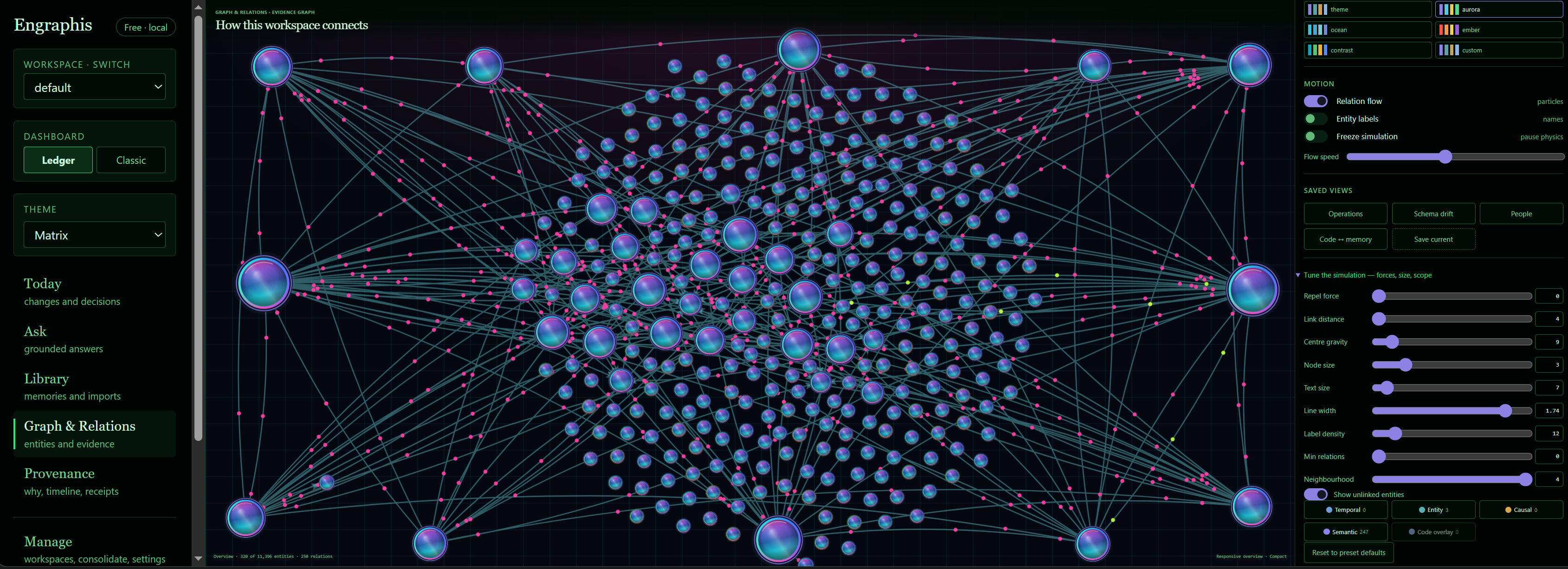
The 12 checks
Score each check as pass, partial, or fail. A memory tool that fails scope, time, or provenance will produce confident answers you cannot audit.
| Check | Why it matters | What to test |
|---|---|---|
| 1. Scope | Scratch work should not become a repository convention. | Store a fact in one workspace and repository, then try to recall it from another. It should not leak. |
| 2. Decision capture | A fact without the reason is hard to trust later. | Store a decision with its trade-off and date. Ask why it was made. |
| 3. Temporal validity | Stale and current facts should not compete as equals. | Store a fact, replace it, then query the old and new states. The old fact should close, not disappear. |
| 4. Provenance | An answer is only useful if you can inspect its support. | Ask for a recall and check that the returned context cites the memory it used. |
| 5. Abstention | A confident guess is worse than a clear miss. | Ask about a decision that was never stored. The engine should say the evidence is insufficient. |
| 6. Inspection | You need to see what the agent remembered. | Open the dashboard and inspect the memory, its scope, its history, and the recall rationale. |
| 7. Local default | Project memory should not require a cloud account. | Run the core offline. Confirm it stores and recalls without a hosted service. |
| 8. Portability | You should be able to back up or move the store. | Find the database file. Copy it, open the copy, and confirm the memories are intact. |
| 9. Write review | Not every agent write deserves prompt eligibility. | Check whether writes can be approved, rejected, or quarantined before recall. |
| 10. Retention | Some memory should expire; some must not. | Define a retention class and confirm the engine respects it. |
| 11. Client coverage | One store is more useful than one store per editor. | Connect Claude Code and one other MCP client. Confirm both see the same scoped memory. |
| 12. Claim honesty | Benchmarks should be bounded and reproducible. | Read the benchmark page. Check the fixture size, the metric, and the reproduction command. |
Run the 10-minute test
Use one real repository and one decision you already know. Do not start with a large import.
Connect the MCP server
Save one scoped decision
Ask from a fresh session
Pass if the new session returns the decision, the reason, the scope, and a citation. Fail if it returns a plausible answer with no source, or if the old fact is still treated as current.
What good looks like
Read the Claude Code memory guide or compare Engraphis and Mem0.
Run the checklist on one repository.
The local core is free and Apache-2.0. Start with one decision and inspect what comes back.
Optional Pro: seven-day trial after email verification; no card required. $10/month or $100/year when you subscribe. Pro and Team include up to 500 managed Jev calls per person per day; calls pause at the daily limit.