Claude Code forgets between sessions. Give it a local memory with receipts.
Engraphis connects to Claude Code over MCP. It stores scoped project decisions in SQLite, keeps temporal history, and returns cited context or abstains when the evidence is weak. The local core is Apache-2.0.
Python 3.10 or newer. No cloud account or API key is required for local use.
Three commands to a memory Claude Code can recall
Install the MCP server in the same Python environment you use for your agent, then connect it once.
Install the MCP server
Create the local config
Add the Claude Code server
engraphis-init writes ~/.engraphis/config.env, generates a local API token, and prints setup snippets for Claude Code, Codex, Cursor, Cline, Zed, and Windsurf. Restart Claude Code after adding the server.
What Claude Code can remember
Memory is most useful when it carries the decision, the reason, the scope, and the date. Engraphis stores all four.
Why the architecture changed
Store the decision, the trade-off, and the date. Ask later why the team moved from JWT to PASETO without re-reading the whole history.
How this repository works
Keep the package manager, test command, naming rules, and review conventions scoped to the repository instead of repeating them in every session.
What changed and when
Superseded facts close instead of disappearing. A later query can still inspect what was believed before and what replaced it.
Which memory supported the answer
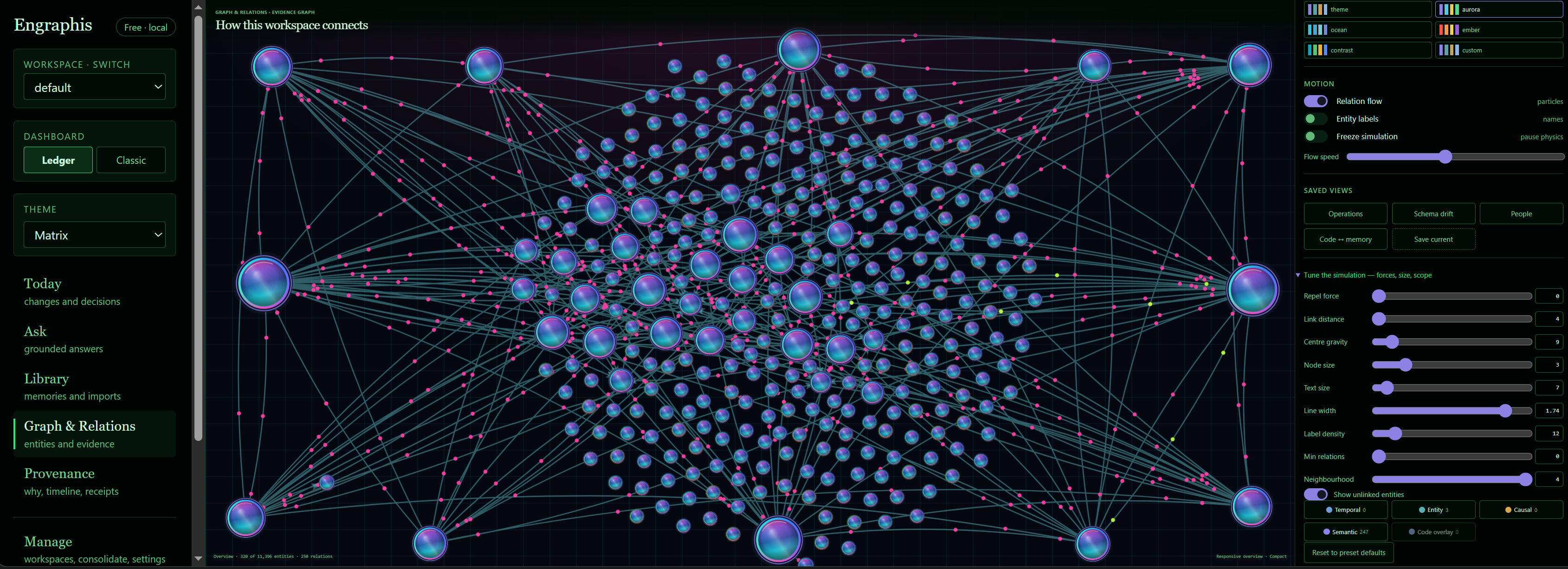
Recall returns citations, and the dashboard shows the record, its scope, its history, and the recall rationale. If support is weak, the engine abstains.
Why a bigger context window is not enough
A context window is scoped to one session. When the session ends or compaction runs, the agent can lose the decision that shaped the code. The next session re-reads files it already understood, then guesses at the reason behind them.
Adding more files to the prompt is expensive and noisy. A flat vector store is also not a memory system: it can return a stale decision and its replacement side by side, with no validity window and no clear provenance.
Engraphis stores the decision as a scoped record, keeps its temporal history, and returns the supporting evidence. The agent gets the reason, not just a similar paragraph.
What makes Engraphis different
Local-first storage and coding-agent scope are the baseline. The temporal and evidence layers are what make recall useful for engineering work.
Compare the design choices with Engraphis and Mem0, or read the agent connection guide.
Benchmark boundary
The published result is deliberately narrow. It is a coding-memory fixture, not a general task-performance claim.
| Fixture | Result | Quality check |
|---|---|---|
| Structure-aware chunking | Mean retrieved top-5 context: 740.3 to 214.3 tokens per question (71.1% lower, 18 questions) | Recall@5 = 1.000 in both modes |
| Grounded decisions | 5/5 answerable queries grounded; 6/6 abstention queries rejected | 11/11 decisions correct |
These are small deterministic offline fixtures. The code and reproduction command are public in the repository. See the benchmark methodology for the checksum, counting methods, and limitations.
Claude Code memory questions
- Does Engraphis replace Claude Code's built-in memory?
- No. Engraphis adds a separate local memory layer that Claude Code can call over MCP. It does not modify Claude Code itself, and you can keep using your existing project instructions and tools.
- Is my code sent to a server?
- The local core runs on your machine with SQLite and local embeddings. Hosted sync and managed processing are separate, explicit opt-ins. You can use the local core without a cloud account or API key.
- Does it work with Cursor, Codex, Cline, Zed, and Windsurf?
- Engraphis works with any MCP client.
engraphis-initprints ready-to-paste configuration for Claude Code, Codex, Cursor, Cline, Zed, and Windsurf. Check your client's current MCP instructions for the exact config location. - What does it cost?
- The local core is free and Apache-2.0. Pro is $10 per month or $100 per year with a 7-day trial. Team is $20 per seat per month or $200 per seat per year with a 14-day trial. Trials require email verification and no card.
- What happens when a remembered decision changes?
- Engraphis keeps temporal history. A superseded fact is closed instead of silently overwritten, so a later query can still inspect what was believed before and why it changed.
Give Claude Code a memory that survives the session.
Free and Apache-2.0. Start with one repository and one decision, then inspect what the agent recalls.
Optional Pro: seven-day trial after email verification; no card required. $10/month or $100/year when you subscribe. Pro and Team include up to 500 managed Jev calls per person per day; calls pause at the daily limit.