Engraphis vs Mem0
Mem0 is a general-purpose memory layer for AI applications. Engraphis is a local-first memory engine built for coding agents: one SQLite file, scoped project memory, bi-temporal history, and cited recall or abstain.
This page compares documented design choices, not benchmark scores. Check each project's current documentation before deciding.
At a glance
The useful comparison is not a feature count. It is where memory lives, what it is scoped to, and whether you can inspect why it was recalled.
| Question | Engraphis | Mem0 |
|---|---|---|
| Primary use case | Coding agents and project memory | General AI application memory. Check current docs for the current product scope. |
| Deployment | Local-first SQLite core; optional hosted sync | Managed platform and open-source options. Check current docs for deployment choices. |
| Scope model | Workspace, repository, session, and record | Application-level memory scopes. Check current docs for the exact model. |
| Temporal history | Bi-temporal validity; superseded facts close; as-of queries | Check current docs for history and expiration semantics. |
| Provenance | Citations on recalled context; abstains below the support floor | Check current docs for citation and provenance behavior. |
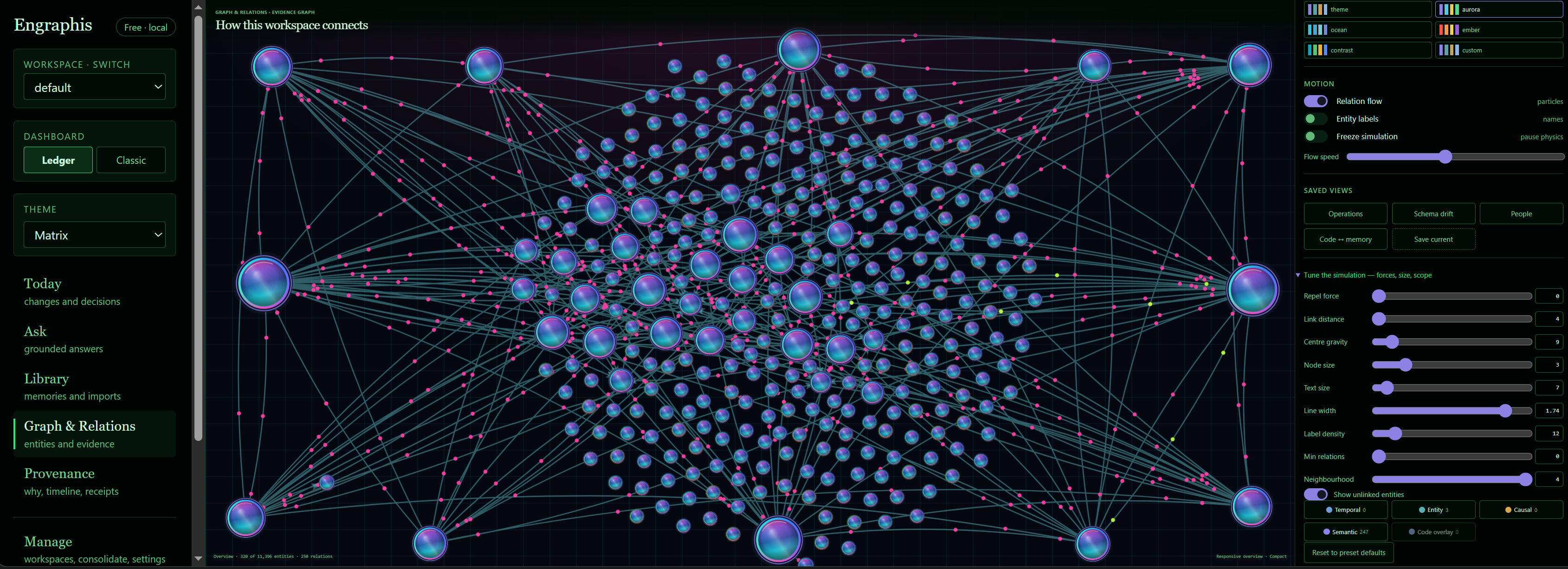
| Inspection | Local dashboard with memories, timeline, graph, recall rationale, and audit | Managed dashboard and APIs. Check current docs for available views. |
| License | Apache-2.0 local core | Open-source and hosted options. Check the current license for each distribution. |
| Best fit | Developers who want one inspectable memory across Claude Code, Cursor, and Codex | Teams building memory into a broader AI application |
Mem0 details are intentionally marked "check current docs" because hosted products change. Start with the Mem0 documentation and the Mem0 repository.
Where Mem0 is a strong choice
- You are building a customer-facing AI application and want a managed memory API rather than a local coding-agent tool.
- You want a general memory layer that can sit behind a broader product, with hosted operations and SDKs.
- Your memory model is centered on application users and conversations, not repository decisions and code history.
Those are real needs. Engraphis is not trying to be a general application memory platform.
Where Engraphis is a strong choice
- You want memory to stay on the developer machine in one SQLite file, with no mandatory cloud account.
- You need project scope: workspace, repository, session, and record, so scratch work does not become a repository convention.
- You need temporal validity and provenance for engineering decisions, not just a similarity search over past messages.
- You use Claude Code, Cursor, Codex, or another MCP client and want one memory store across them.
- You want to inspect and audit what the agent remembered before trusting it.
The difference that matters for coding agents
Coding-agent memory is not chat memory. A decision has a repository, a reason, a date, and often a successor. Storing it as a flat text blob loses the structure that makes it useful later.
Engraphis closes superseded facts instead of deleting them, so an agent can answer what the team believed last month and why it changed. Recall fuses vector, lexical, graph, and code-symbol search, then cites the memory it used or abstains when support is weak.
That is a narrower product than a general memory platform. It is also the difference between a plausible answer and an answer you can inspect.
Read the Claude Code memory setup guide for the three-command install.
Benchmark boundary
Engraphis does not claim to outperform Mem0 on general memory benchmarks. The published result is a small deterministic coding-memory fixture.
| Fixture | Result | Quality check |
|---|---|---|
| Structure-aware chunking | Mean retrieved top-5 context: 740.3 to 214.3 tokens per question (71.1% lower, 18 questions) | Recall@5 = 1.000 in both modes |
| Grounded decisions | 5/5 answerable queries grounded; 6/6 abstention queries rejected | 11/11 decisions correct |
These are small deterministic offline fixtures, not a general task-performance claim. See the benchmark methodology for the checksum, counting methods, and limitations.
Engraphis and Mem0 questions
- Is Engraphis a drop-in replacement for Mem0?
- No. Mem0 is a general-purpose memory layer for AI applications. Engraphis is a local-first memory engine built for coding agents, with project scopes, temporal history, and a local dashboard.
- Can I use Engraphis and Mem0 together?
- They solve different layers. Mem0 can support memory in a broader AI application, while Engraphis can hold the local coding-agent memory for a repository. Check each project's current documentation before combining them.
- Does Engraphis require a cloud account?
- No for the local core. It runs on SQLite with local embeddings and needs no cloud account or API key. Hosted sync and managed processing are separate, explicit opt-ins.
- What does Engraphis cost?
- The local core is free and Apache-2.0. Pro is $10 per month or $100 per year with a 7-day trial. Team is $20 per seat per month or $200 per seat per year with a 14-day trial. Trials require email verification and no card.
Try the local core on one repository.
Store one decision, open a new session, and inspect the cited recall. The local core is free and Apache-2.0.
Optional Pro: seven-day trial after email verification; no card required. $10/month or $100/year when you subscribe. Pro and Team include up to 500 managed Jev calls per person per day; calls pause at the daily limit.